Wednesday, May 30, 2018

The Old White Guy in the Sky

Genesis 1:26-27

I love going over this story of Creation with the youth group during confirmation classes. There are a few of these quirky events in the Bible where you think you know the details but it turns out they are made up—like the number of wise men who visit baby Jesus—we think there are three because three gifts are listed but the actual number of people who traveled to see the Christ Child is never revealed. The youth are always surprised when they find out there are two creation stories—this seven day one with God saying things like, let there be light and then creating humankind and then the story in the next—you know the one where the man is created and given the job of naming all of creation and God feels sorry for him being all alone and creates a woman from his rib. Two very distinct stories of creation. Anyway, the creation story Donna read for us is from chapter one and takes place after God has created everything in the world, except for humans. We don’t know much about God at this point other than how powerful God must be to have created so much out of nothing. Over these next three weeks, Stephen and I will be exploring the images that we have for God. Many of us grew up in a time in which there was not much question of how we would describe God if asked—the answer would likely be, an old white, bearded man, living in heaven up in the sky. I don’t know about you but when I was younger I couldn’t help but think of Charleston Heston like in this photo—he was actually playing Moses but to my mind, this is how I thought of God while I was in Sunday School.  It’s hard to know when this older male image of God was created in the imagination of humanity—perhaps Michelangelo had something to do with it when he revealed his painting in the Sistine Chapel—you know the one, where God is creating humanity by reaching out and touching fingertips with Adam.

Translating the Bible into English would likely also have been a factor. The Old Testament, the Hebrew Scriptures, were written in Hebrew. Hebrew does not have pronouns such as the English language—no ‘he’ or ‘she’. But the Hebrew language does assign a gender to all things in a similar way of the French language. As such, God had a masculine designation, not necessarily because the early Hebrew people understood that God was a man, God was just happened to be masculine. I suppose, it’s just as likely God could have had a feminine designation just as the Hebrew words for grapevine or sun. Of course, later in the Christian Scriptures, the New Testament, Jesus refers to God as Abba, which is Aramaic for father—abba refers to a relation of personal intimacy—which is exactly what God is to Jesus. Jesus was likely very aware of the story of how his mother was made pregnant through divine intervention and so it follows that Jesus would have thought of God as his father, therefore directing humanity’s imagination to the image of a older man. The lighter features of God comes from the very fact that it was western Europeans who have had authority over the church for so many years. Using English, Bible states, God created humankind in his image. The word for God is masculine and the English language requires a pronoun to be used in this situation, so the sentence is God created humankind in HIS image. Our history had men interpreting the Word of God for the people, and so they read this bit of information revealing what God was and they looked at themselves. Their logic probably went like this…if God made us in his image, we must be what God looks like. Which leads us to the pervasive uses of older, male imagery for God today. Even in the TV show, The Simpsons, the character of God is light skinned and has a long white beard. Here’s a fun fact that I’ve shared before but I still like to point it out…God is the only Simpson character to have five fingers, the other characters all have four fingers on each hand.

There is nothing inherently wrong with this older male imagery for God other than it can be restrictive when portraying God if other perspectives are not permitted. The English language is limited when it used to describe the Holy Mystery that is God. Last week we heard the early Christians speaking about the Holy Spirit using images of fire and the sound of wind because they did not have the language to describe the fullness of how God was moving in their lives on the day of Pentecost. As much as we try, developing a comprehensive image of God is very, very difficult, impossible even. But humanity, as a general rule, likes order in the world. And, let’s admit it, we the faithful, like rules and organization. If you need any proof that humanity values consistency as a virtue, have a look at the success of McDonalds or stand behind someone at Starbucks as they discover the location they are at has run out of earl grey tea. You can’t possibly make a tea latte with anything other than earl grey. And, no, English breakfast is never, ever an option for a London Fog, thank you very much! As much comfort rule and order offers to us, sometimes consistency can be filled with ruts that are hard to escape. And when our religious structures become too rigid with the portrayal of God, there is not room for those people who do not find comfort or peace in those portrayals. If a child suffered at the hand of their father growing up, perhaps the image of God as the loving Father cannot be reconciled with their abusive father. If a person has been sexually assaulted by a man, it might be hard to find comfort in praying to a man for strength and courage. There are also people who find it challenging to consider the greatness of God’s mystery being contained within any type human form. It is helpful for those folks to be given space for God to be more, to be bigger, to be wider than any one person. For people whose vision of God does not include Charleston Heston, we to allows for an expansive view of the one we call the Almighty.

Let’s take a moment to look at our scriptures to examine what they tell us about God. There are many, many descriptions for God throughout the whole Bible—metaphors such as fire, wind, the quiet after a storm and also characteristics such as being just, loving, wise and in all places at all times. So, in this very first chapter of the entire Bible, we find ourselves at the end of a rather impressive list of things and creatures that God has managed to create and we know that all of it is good. Then God makes humankind. In a stunning revelation we find out suddenly that God does not seem to be alone. God says, “Let US make humankind in OUR image.” It turns out that God is not an ‘I’ but rather, God is an ‘us’. As an aside here, this is a piece of scripture that certain Christians use to explain the Trinity and to ‘prove’ that Jesus was with God since the very beginning of time. However, the same Christians then ignore the next few lines and use only the creation story from chapter two to explain how women are to be subordinate to men. But I’ll leave that for another Sunday. So, to recap, God is an us, not an ‘I’ and God wishes to make humankind in their likeness—again plural rather than singular. God goes ahead and makes humankind and AGAIN we hear plural not singular—God created THEM. Male and female.

Did you notice that the male is not named Adam in this story? That happens in chapter two. The Hebrew word for red dust is adama and it is believed that Adam is named for the dirt from which he was created. Back to chapter one and the male and female being created together. One thought is that this one being had the male facing from one side and the female facing from the other. Psalm 139 says, "You hem me in—behind and before, you have laid your hand upon me.” At some point, they were separated. Or it could simply be that both were created at the same time as individual beings. What is important to take away is that both men and women were created in the likeness of God. Which then begs the question of how it is that we haven’t used other images for God alongside the father, an old man with a beard? If we, each one of us, are made in the image of God, we do not have to look very far to find out some of the possibilities of what God is. Male, female, transgendered, homosexual, heterosexual black, brown, white, tall, slim or wide.

Last summer, in Zambia, in response to the question as to why the United States and Canada had so many gays when Zambia had none, I told the Zambian taxi driver that we, in Canada and in the United Church know that a person has no more control over whether they are born gay or straight than they are born black or white or male or female. We are born the way we are, just as God would have us be. And each and every one of us is made in the image of God. God can be many things. I’ve shared here before that when she was four years old, Abigail described God as being big and blue and riding a bike. I think of God as being a big cloud type of thing, like a massive flock of birds that move in tandem together in the sky—as the love from which we are born and the love to which we return when our time on earth is at an end. But it is helpful for me, particularly when I’m in the drive through line at Tim Hortons and I’m feeling tense about who might cut into the line to remember that each and every one of us reflects God and all the possibilities of God. However, individually we are not the sum total of all that God can be. Remembering that God created humanity, both male and female together from their likeness—from the plural we were created into community. Neither one alone is the full image of God—only in the community of humankind is God reflected. For us to begin to understand the Mystery of who and what God is and the power of God in our world, we need to be with each other. We need to be together, acknowledge one another, try to understand one another, be loving to one another, offer grace to each other just as God’s grace is given to us, to ensure justice for our neighbor as we would want for ourselves, to be compassionate and full of mercy just as God is, for each and every one of us is made in the image of God. God has created us into a community in which we are encouraged each and every day to call each other into full being in fellowship, a fellowship that can only be accomplished when we look at the other and recognize that God is as reflected in the person before us as God is reflected in ourselves. And, if you need reminding of all the possibilities of who the US is that is our God, of the US that made humankind in their image…here are some photos of just a few in this world who bears God’s image…

**At this point a slide show of images of a diverse group of people, including Donald Trump, Syed Soharwardy and Wab Kinew- photos and selfies - appeared on the screen while Donna and Karen sang I Am a Child of God - #157 More Voices - by Cheryl and Bruce Harding, 2002**

Thursday, May 24, 2018

Is it Pentecost? Or an Ice Cream Truck?

Acts 2: 1-21, 41-47

Video shown at the start of the message time: The Skit Guys: Pentecost. The characters are talking about the excitement of Pentecost and one of them wonders if the sound from heaven they are hearing is an ice cream truck - because what is more heavenly than the sound of an ice cream truck entering your neighbourhood?
During the scripture reading, an emoji version of the reading appeared on the screen - see below for the emoji reading.
These are my notes that I used to speak with the children (and the congregation).

Pentecost is a time of celebration – it is the birthday of the church. Just at the beginning of Acts, Jesus ascended to heaven after spending some good, quality time with the disciples. They witness him rising up towards the sky and they stand there, dumbfounded. What were they to do? How were they going to manage? And then some bright spark says, why are alls y’all standing there just looking up? Jesus is going to return one day. The disciples stop looking up and start looking at each other and realize they have work to do. They return to Jerusalem and go about replacing Judas with Mattias. They begin to pray together in one another’s home and one day, fifty days after Easter Sunday, they find themselves in a unique set of circumstances. What they later can describe only as the Holy Spirit descends upon them and transforms them from the students of Jesus to the apostles carrying on the ministry that Jesus began when he was born into the world as the Word Made Flesh. They were not the only ones affected that day. People from all over the land experienced the Holy Spirit moving that day.
As much as we have tried to contain God to certain images or descriptions, God is so much bigger and mysterious than any language we humans could possible use. We are limited in our understanding and knowledge of the wholeness of what God is and what God can do in our world and in our universe – we have no idea. Which is why Christians have three expressions and understandings of God. We call it the Trinity. While there are many ways to describe them, here is one way – God the Creator, Jesus the teacher and the Holy Spirit, the inspirer.
In an attempt to express how they experience the spirit of God, the early Hebrew People often used the imagery of wind or breath to describe how God moved in their lives. Breath of God – ruach, a Hebrew word meaning wind or breath – refers to Spirit of God or the Holy Spirit
The early Christians experienced the Holy Spirit in the sound of rushing wind but there were earlier cases of the disciples comparing the Holy Spirit to wind…
Book of John – 3:8 – Having just said one must be born of water and Spirit to enter into the kingdom of heaven - The wind blows where it chooses, and you hear the sound of it, but you do not know where it comes from or where it goes. So it is with everyone who is born of the Spirit.’
John 20:22 – breath – In the locked room after his resurrection to the disciples Jesus said, “When he had said this, he breathed on them and said to them, ‘Receive the Holy Spirit.”
Making Wind (We made the sound of a thunderstorm using the campfire game of rubbing our hands together, snapping fingers, clapping hands and stomping our feet as loud as we could.)
Another image the early Hebrew people used for God was fire. Can you remember when fire was used in the Old Testament – Hebrew Scriptures – to represent God? The burning bush. And now today we hear that tongues – not tongs – of fire came down upon the people of God, to show the Holy Spirit moving in their lives. Let us create an image for ourselves.
Making Fire (The children and members of the congregation were invited to come forward to light a bunch of candles in the sand table on the stage. The lit fire at the top of the tall tapers brought to mind what the tongues of fire might have looked like resting above each person at the time of Pentecost.)
We welcomed three new members during this service. Following the service, we shared a potluck meal together, had a Pentecost treasure hunt, sang happy birthday to the church and then shared this awesome cake (made by the great Heather Klekta).


Tuesday, May 15, 2018

Marching Onward

Disclaimer
I began writing this blog sometime near the end of March.
PEOPLE - it's now MID-MAY!!! I no longer have any idea how time works.
---------------------------------------------------------------------------------------------------------------------------
I've been serving in full time ministry for almost seven years and I still find myself surprised that the distance between Ash Wednesday and Easter Sunday is so very, very short. When I was a kid, six weeks was an eternity. Remember what it felt like when the first day of summer holidays or Christmas Day was six weeks away and EVERY single day was like a full week worth of time and so it took FOREVER for the celebrations to begin? Pure torture. But now it seems the six weeks of Lent fly by in the blink of an eye. Which is all to say, that I did, in fact, read my March books but the blinking of my eye did not allow for me to sit down long enough to write about them. I found a little time today, in the quiet of this Wednesday afternoon to reflect on the books I read last month. (And now it's a Tuesday in May. SIGH.)

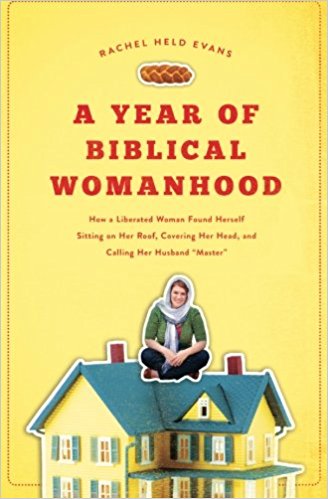
I began March by reading A Year of Biblical Womanhood by Rachel Held Evans. You will recognize Evans name from previous books I've written about in this blog. Evans is a former evangelical Christian. She is still a Christian but no longer identifies as evangelical. She spent her twenties exploring what aspects of Christianity remained important to her and what aspects of her Christian upbringing she needed to let go of in order to live faithfully as a loving and compassionate servant of God.

In her former evangelical world, there had been much emphasis on controlling what women could and could not do as a follower of Christ. Supporting her husband by staying home and raising children was on the "Do" list. Preaching or being in church leadership was on the "Do Not Do" list. Whenever a woman moved out of her lane, so to speak, she was likely to be reminded of her role in God's world. As part of her faith journey, Evans decided to earnestly explore what the Bible (and presumably God) had to say about what it is, exactly that is expected of women and live a year following what biblical rules she could find about womanhood.

After culling the Scriptures for all references to how a woman should behave, Evans selected 12 virtues and did her best to fulfill them, one at a time, each month - following some general guidelines on how to act or not to act such as she didn't cut her hair for a year and covered her head when instructed to do so. The virtues were: Gentleness, Domesticity, Obedience, Valor, Beauty, Modesty, Purity, Fertility, Submission, Justice, Silence and Grace. Many instructions of how the biblical woman is to behave can be found Proverbs 31.

And this is my confession...I got four months into her year of biblical womanhood and became so annoyed with the whole project that I put the book into a time out. There are so many reasons to be annoyed with a religion that attempts to restrict woman that it would be impossible list them here. So I won't. I will just say, the book sits somewhere between my complete pile and my desk and every once in a while I pick it up but progress is slow. Life is too short to read books that cause existential angst.

The next book I read, however, did not cause me any angst other than to be sad that there will be no other books coming from its author, Marina Keegan. Unfortunately this author of The Opposite of Loneliness was killed in a traffic accident within her days of graduation from university. She was a talented writer and had volumes of material which her parents and former instructor curated to create this tribute to this wonderful and talented young woman. The book has a variety of fiction and non-fiction selections.

I want to lift one idea from Keegan's book. She wrote an essay for the graduation issue of the Yale Daily News. She speaks of the variety of communities that she found herself at home in while studying at Yale. She mentions that there is not an opposite word for loneliness. If there was, that is what she felt while at Yale - the opposite of being lonely. As I was sharing this essay with someone who joined the Brene Brown book study earlier this year, he told me - "I know what the opposite of loneliness is - it is belonging. Brene Brown taught us that." Lovely.

This book is definitely worth the time. If you'd like to borrow it, please just ask. You can borrow the other one too. 😉

Next on my list (For April. Cause, remember, I don't know how time works.):
Reasons to Stay Alive  by Matt Haig and a biography of The Reverend Dr. Martin Luther King Jr.


Thursday, May 3, 2018

The Purse is Stalking Me!


Romans 12:2


For this month of April, we have been exploring a variety of spiritual practices. And because Stephen and I appreciate a certain amount of good and reasonable order to things, we chose spiritual practices that all start with the letter ‘s’. For a long time in our schedule, this Sunday’s topic was listed as “another s”. As it was my Sunday to preach, it was up to me to find a spiritual practice that I wanted to talk about which also happened to be an s-word. And I just could not find one. Until one day, as I was writing in my bullet journal (and if you want to know what a bullet journal is, come talk to me later) but as I was working in my journal, I thought, that’s it – I want to talk about journaling. But journaling does not start with an s. So, I did what I had to do when we were naming child number four. We both liked the name Abby if the baby was a girl but because our naming rules (and, yes, we had naming rules to help in the choosing of names for our kids—that’s one of the many joys of living with me—just ask my dear spouse). Anyway, the naming rules included the rule that no one would be named with a nickname. They had to have a full name. So, we agreed on ‘Abby’ but then had to work ourselves backwards to get to Abigail. This is what I had to do with the word journaling—which, if you think about it, is just another way to say writing. So is the word scribing. And so here we have it—another s to round out our month.


Stephen explored the practices of stillness and simplicity. For the Sunday we looked at the practice of sabbath, Dave Robertson spoke about how he used cycling to deal with his cancer diagnosis, which has recently returned with no good outcome in sight. And today we are looking at how we can use writing, journaling, scribing to calm our minds, ease our souls and allow the Divine to enter into our here and now. As people of faith, we use spiritual practices for a variety of reasons however the fundamental purpose of a spiritual practice is to make space in our lives for the Divine. You will notice that we have not specifically mentioned prayer. Prayer is, of course, a spiritual practice but we wanted to lift up these other particular practices which cause us to declutter, so to speak. They allow us to clear out and make room for thoughts and ideas to flow unencumbered. They free up time in order to allow the processing, for different experiences to be uncovered, layer by layer. And then, sometimes in those times of making such space, prayer can be known to leak out of us. Maybe it happens by accident. Maybe it happens on purpose. But I think in times in which we open ourselves up to self-exploration and discovery, prayer happens. The Divine is sought. Or maybe it is that you realize the Divine is seeking you. You simply give thanks for what you have or what is before you. Or you cry out for help because it all seems impossible. Or, like so many of us, you begin the complicated process of negotiating for peace of mind and soul. Perhaps then, the Holy Spirit might move. Maybe it moves gently like a breeze brushing ever so gently past our cheek. Or maybe it moves with an insistence such as when the wind grabs at the front doors of our church on certain weather-filled days up here on this hill we sit upon. The moving of the Spirit sometimes reveals to us an answer we’ve been seeking or sometimes points us in a direction we had not previously considered. Spiritual practices make space for God to be made known in our everyday living. 

Our first scripture reading today was from Proverbs. The Book of Proverbs is regarded as a collection of wisdom—a significant set of teachings of how to live a happy and peaceful life by honouring and respecting God as all good and all powerful. Today, from chapter four, we heard that above all else we are to guard our heart as it is the wellspring of life. For anyone who has had their heart broken by a lover, a friend, by a family member, we know that it is instinctual to protect our hearts after a hurtful event by turtling in, wrapping ourselves so tightly around our hearts that it is hard, on most days, for another to find their way in. But, the way of God, the way of Christ, is not to wall off our hearts. Rather than close up hearts from the world, our God calls us again and again to keep our hearts open, as the hymn says, to the joy and pain of living. To keep ourselves open we must dare to be vulnerable and reach outward rather than retreat inward. But we can’t protect ourselves in a world that has little regard for our tender hearts until we know ourselves well and believe firmly in the path before us. And we can’t know these things unless we take the time and space to explore matters within us. Proverbs goes on to tell the reader to keep corrupt words from leaving the mouth, to keep their gaze straight and to not veer off their path. But how is one certain which words are not corrupt? Or that the direction in which one is looking is the correct one? Or, for that matter, that the path one is on is the path set by God? Paul tells us in his letter to the Romans. By renewing your mind and testing what it is that is God’s will. By taking time to allow God to enter in and speak. For giving space to seek out God and for God to find you. 

Paul knew that making and keeping a connection with God is a difficult thing in a world that is out to get us. Well, maybe it’s not the world, as in God’s creation that’s out to get us—unless, of course, you don’t count the poisonous spiders or the spiders that are so large that they are likely to induce heart spasms when you encounter them—if you can just set those aside, I don’t think it’s so much the world that’s out to get us so much as it is humanity’s need for conformity that’s out to get us. In order for humanity to first survive, in the beginning of time, humans had to band together to hunt and protect themselves from the elements of nature. Now our survival is directly tied to understanding the necessary social norms for one to advance and succeed in supporting oneself and families. In order to survive, humans have always had to conform to what the collective did or believed. Society through politics, religion and social groups pressure us to stay within certain boundaries of tradition and customs and, this way, we are marked as who we are supposed to be and what we are to believe. 

Advertising pushes us further to conform to whichever groups we belong. Everyone has what they are selling and shouldn’t you also have it? Or, better yet, you can belong to a more elite group if you just get this other, more expensive thing over here. And we know from recent revelations from Facebook that we are being manipulated and coerced in ways we never understood before. Although the news really wasn’t all that surprising. I am currently being harassed by a purse on Facebook. I made the mistake of expressing an interest in a certain very lovely bag that popped up in my Facebook feed and now the advertising for that bag is stalking my every moment I’m on Facebook. I have yet to come up with a logical rationale for Christopher as to why I should just buy the darn purse so it’s still lurking there in my newsfeed whenever I log on.

So far, I am holding strong. But that’s just a purse. What about those advertisements or postings that prey upon those who have been hurt? Who are broken? Who are lonely? Who feel inadequate or not worthy? And who amongst us has never found themselves in one or more of these categories? And so, when we see signs or notices that encourage ways of thinking that dehumanize others, that dismisses the goodness and the joy of others, that disregard the truth of other people’s experiences and lives, how do we advert our gaze? Because not being conformed to a world of fear and scarcity that certain leaders uphold is a tall order. To believe in a world of love and abundance, this world of possibility that God has been telling humanity about since the beginning of time, a world of peace and unity that Jesus taught about for his whole ministry, to believe in this type of world is to fight every moment to look the other way rather than to allow the glimpses of injustice, hatred, oppression, immorality, greed and violence to define our world.

‘Do not conform any longer to the pattern of this world but be transformed by the renewing of your mind.’ It takes transformation, a renewal of the mind, to detach ourselves from the world’s attempts to occupy us with things that do not matter. Paul implores us to shake off the negative effects of this world and attend to things that matter and to discern what is good. Transformation such as this happens only when we take the time to ask questions, to express our doubt, to search ourselves for what we know to be true, to notice how the Holy Spirit has and is moving in our world, to allow for the teachings and sayings of Jesus to be the wisdom and truth guiding our actions and to listen for the small, still voice of God, that continues to speak to us whether we can hear it or not. And how do we do that but through spiritual practices such as scribing otherwise known as journaling.

Now, I have a small confession to make. After all this working towards how journaling can be beneficial in making a connection with the Divine and discerning how best to live your life, I woudn’t blame you if you thought that I might be pretty great at journaling. I am not. My journaling totally follows how I approach completing tasks. I don’t. My personality type is very much about starting things. Not finishing things. So, I have journal after journal of all the trips I’ve been on. They all look the same. I start out strong with lots of details of the activities we’ve done and the people we’ve met and, inevitably, by day four or five, my writing begins to wane. And by the end of the trip I’m too exhausted to write anymore. Oh, I always, always tell myself I will go back and fill in the missing details. But I never do. Oh my goodness, I just picked up a lovely looking journal that I’ve had for awhile. It was like walking down memory lane as I looked at the variety of entries I had written. Apparently, I bought it for my last year of ministry training.

I don’t journal well but I like to draw. I’m not an artist like my mom was but I like using colour and making simple line drawings. I often find myself praying in a free-flow kind of way when I do that in my journal. I also like to make lists. When I am feeling anxious or overwhelmed and I’m fretting, Christopher says, why don’t you make a list? And he’s right. What the list is listing doesn’t even really matter. It’s the action that allows me a moment of feeling like the world is not completely out of control. And as often as not, the Holy Spirit will move as I’m making the list and I will notice what’s been missing and has been the cause of my underlying anxiety. Or She will make explicit that what I was worrying about really isn’t the bother of worry about it. There was a time, when our house was chaotic with four children between the ages of 1 and 7, with three very energetic boys who loved to cover their baby sister with stickers or stick her in a laundry basket and see what they could do with said-basket and I felt like I had NO space, time or energy to talk to God, much less hear God speaking to me. But I found if I sat down just before I went to bed and jotted down all the things swirling in my
brain—the to-do lists, the things I needed to remember, a funny thing the boys said or did—I would jot it down in a journal beside my bed. When I was done, I would close my eyes for a moment and think, “There you go Jesus—you take it. Thanks.” Christopher called it my, ‘giving it over to Jesus’. And I would sleep pretty well those nights, except for, you know, the nights where there was barfing, I had a nightmare, I can’t sleep, the night terrors—other than those events, I usually slept well because I didn’t have all those thoughts distracting me and bothering me—Jesus had them. And the next morning, I had a look at the list and notes and I took back only those that needed doing. Because, remarkably, somehow in the night my brain had the space to come up with solutions for some of the concerns that I had been worried about the night before. I think, maybe, this is some of what Paul was writing about, be transformed and discern what is good and acceptable and perfect.

Not all spiritual practices work for all people. It is a well-known fact that I can’t sit still or stay quiet for much longer than an hour so a silent, six-day yoga retreat like the one she did in Eat, Pray, Love is definitely not for me. My brain might explode. But I know plenty of others who would love that type of practice and would learn so much about themselves and how they want to be in the world. Simplicity would work for me if we could agree that my craft room is not included and no laundry baskets for sorting go near it. And Sabbath for me is Monday. Just as Dave cycles, I have my own routine for Mondays that give me the space and the freedom to work through thoughts and feelings from the past week, to make my lists for what’s coming and to do certain activities that allow my brain to shut off for a little while and make room for God to enter in. We have had some pretty good chats, God and I, on Mondays. Not that God isn’t in and around my life other days of the week, it’s just that I listen best on Mondays. And I journal. In my own way and with lots of different colours. In a variety of notebooks. Which I am definitely not hoarding. What practice works best for you? What gives you the freedom of space and time to connect with the Divine? What do you do to allow for transformation to take place, so that God can enter in, so that the teachings of Jesus can be considered, so that the Holy Spirit may move in your life? God is always with us but sometimes it can be hard to see or hear how God is working in your life. Finding a spiritual practice that works for you, will work for God and reveal more clearly that God is indeed working in your life and in this magnificent world of ours. Thanks be to God.

Thursday, March 8, 2018

On Being Wild

Do you remember the TV show, Gilmore Girls? Before a year and a half ago, I wouldn't say that I did. The show was on from 2000 to 2007 - the precise time I was in the midst of losing my mind trying to keep between two and four little humans alive and somewhat healthy. I had two boys, aged two and under, when the show started. There were four children (another boy and then a girl), between the ages of nine and three by the time the show ended. When I sat down to watch TV in those years, it needed to be the type of show that did not require any sort of maintenance of keeping up with story lines. Law & Order and Survivor were my kind of shows back then.

2012. Or was it 2013?
Fast forward a decade and life has gotten somewhat easier in that keeping the children alive no longer requires vigilant monitoring of their every move. Now I sit in wait, cell phone at hand, ready to help solve transportation issues, giving meal suggestions and taking part in discussions on whether or not the unnaturally bent finger requires a trip to the ER or not. And I can watch TV again. Or rather, I can partake in the joy that is known as Netflix.

I am one of those people who like to start things at the beginning. My dear spouse can just pick up watching TV shows wherever they happen to be in a series. I cannot. I need to start at the beginning. I'm like that with book series too. So, Netflix is totally my jam. I've watched more than few entire series of shows while putting in time in my sewing room. Grey's Anatomy, Scandal, Shameless, Grace & Frankie, 13 Reasons Why and, not only Gilmore Girls but also Gilmore Girls: A Year in the Life.

If you have watched the follow up season to the Gilmore Girls, and I am, in no way, recommending that you do (it was a disappointing reincarnation of the TV show - as I suppose most reincarnations are - and I know some of you will give me grief over this but, you have to admit, I'm not wrong), you will know that the mom, Lorelai, at one point has an existential crisis and decides that she needs to be off by herself for awhile. Her solution is to go be wild. Not wild, as in 'out of control' but be Wild, as in follow in the footsteps of Cheryl Strayed, who hiked the Pacific Coast Trail (PCT) and wrote a book about her experience.

Before I watched that episode, I had a vague memory of the movie of the same name coming out starring Reese Witherspoon but had had no interest in seeing it for some odd reason as I normally quite enjoy Reese Witherspoon's movies. A memory that stuck with me from Lorelai trying to be Wild was that an important component of the being Wild was that one had to throw their hiking boot over a cliff. Which struck me as odd. I didn't get the joke. I didn't know the inside story, which obviously was nagging at me at some subconscious level over this past year. When I sat down to select books to read for my 2018 26 books in 52 weeks challenge,  something triggered in a small recess of my brain and I included Strayed's memoir of her hiking the PCT.

Not only did I find out about the boot throwing, I found out all about it on page one. And despite having that itch immediately scratched, I couldn't put the book down. I don't normally enjoy these types of memoirs but Cheryl Strayed is a talented author who knows how to carry a narrative. The book is filled with facts about the PCT and the mountains the Trail goes up and over that I never knew I would care to know about but am now glad that I do. She shares details of her past life that are neither flattering or inspiring all the while she is managing to hike some 1100 miles with a ginormously heavy pack on her back.

The PCT
I found Cheryl's book to be quite endearing. I kinda sorta (and know that I never will) want to hike out in wilderness as she did, carrying all that I need on my back. I'm happy that she did it so I can know, in some sense, what it might be like. I understand some of Cheryl's pain of having lost a mom too soon but I don't know how to feel about the decisions she made in her early adult years. I appreciated how open she was about her fears, her struggles, her selfishness, her uncertainties, her anger. I also appreciated journeying with her as she began to heal from the inside out, as she received generosity from nearly every person she met along the PCT, as she learned more about who she is and how she wanted to be in the world once she arrived at the end of the 1100 miles.

I loved this book. If you want to borrow, just ask. What's next on my list? Something TOTALLY different...A Year of Biblical Womanhood. I kid you not.

Monday, March 5, 2018

Celebrating 10 Years of Affirming Ministry

The Annual General Meeting of Symons Valley United Church takes place on the last Sunday of February. This year's AGM marked the 10th anniversary of SVUC becoming an affirming congregation. To be an affirming congregation in the United Church of Canada means that there is full inclusion of all people of all sexual orientations and gender identities. In order to become an affirming congregation, a congregation needs to go through an intentional discernment process and then hold a vote at a congregational meeting. More information about the process can be found at the Affirm United website.

Symons Valley United Church also moved into a new building, in a new community ten years ago. As several new communities build up around us, we have many newcomers attending worship services and programs. Over these past few years, we have had many folks join the congregation and so when the plans for recognizing the 10th anniversary of becoming affirming were being made, it was realized that we should recall some of the history of what led the congregation to begin the discernment process. Alice, longtime member of the congregation who participated in that discernment, gave an oral history via recorded video of the events leading up to the affirming vote. Alice recalled how the congregation felt strongly that God's call to love all people was not limited in any way. She also spoke about how the process to become affirming resulted in a deeper commitment to be an open and loving community especially in light of moving locations and opening their doors to the new residents moving into the surrounding communities. Here is the Statement of Affirmation that now hangs at the front entrance of the church building:
We believe that all people are sacred in the eyes of God, welcome at God's table, and entitled to full and equal participation in the life of the church.                              We recognize that congregations have historically condemned and excluded some persons and groups of persons through active effort or complicit silence.             In response to our understanding of Christ's invitation to the table, we declare that we will: continue to be open and affirming of all, regardless of age; ethnic, cultural or spiritual background; sexual orientation, gender identity; family composition; or physical or mental capability, and we will work to live out diversity and justice through our actions and our witness in the world.
Shari D followed the history recounted by Alice. Shari's story with Symons Valley began nearly four years ago. When she and her husband returned to Canada with their two children after a few years of study in California, they were looking for a church that was open and inclusive to all. They found Symons Valley by searching for 'gay-friendly churches' in Calgary. When they entered SVUC for the first time, they had a good feeling about the congregation when they saw the rainbow hangings that greet everyone at the front door. Shari spoke about how she appreciated the welcoming nature of the people of the congregation. Over time, as they got to know people, Shari noticed that same-sex couples were treated just as she and her husband were treated.

The third person to speak in our celebration was Letitia. Letitia and her partner Shauna began attending SVUC soon after Shari. Letitia first became connected to the congregation through our annual dinner theatre production - she volunteered to do hair for the production. One of the performance days, she noticed the rainbow candle on the communion table (we store it backstage during the week). She asked, 'does that mean what I think it does?' She was told that it did. When she mentioned that her partner was a female, the response was, 'Oh? Is she coming to the play?' With that, she and Shauna decided to try coming one Sunday. With her Catholic upbringing, Letitia mentioned that she was not certain how she and Shauna would be received but they came anyway. She recalled being somewhat shocked at how the fact that she and Shauna were not made to feel uncomfortable because they were a couple. And so they came back the next Sunday. And have been coming ever since. Both Letitia and Shauna are now active and vital participants in congregational life, including singing in the choir. We are a more full and loving community of faith because of them.

I began serving Symons Valley United Church nearly seven years ago. There have been many moments over these years in which I have been so proud to walk this journey of faith alongside the many good folks of Symons Valley UC but never more so than during this celebration of being an affirming congregation in the United Church. Only about 5% of congregations in the United Church are affirming despite the fact that it has been thirty years since the denomination voted to ordain and commission openly gay and lesbian clergy. Here in Calgary, just over half of the congregations in the city limits are now affirming. There is still a lot of work to do in this world of ours which still has pockets of ignorance and bigotry regarding LGTBQ+ issues and human rights. God, Jesus and the Bible are still being used to promote hate and violence against the LGTBQ+ community. While we cannot change everyone's understanding and point of view, we can be the change we want too see in the world. I see God's love being poured out by the faithful folks of SVUC and celebrate that they made a decision ten years ago that declares for all who ventures in that God loves them regardless of their shape, size, colour or who it is that loves them or who it is that they love. Full stop.

Thursday, February 22, 2018

Belonging Everywhere and Nowhere


Have you heard of Brené Brown?
Yes? Skip this paragraph.
No? Then watch here in her first Ted Talk.

Seriously.

Right now. Spend 20 minutes and get to know her.

DO IT.
Okay, good. Now you know why I like reading her books. She writes in the same way she is able to tell a story. She knows how to tell a good tale and all the while she's talking, you are learning something. At the very same time.
At Symons Valley United Church we have found a pattern of doing a book study after Christmas. Often into Lent. Folks like to be challenged a little bit but, like all of us, don't want to be burdened by texts that are dense or too academic. Last year we read Brené Brown's Daring Greatly and everyone loved it.

This year we are reading her most recent book, Braving the Wilderness. In preparation for the book study, I read the book as my 2nd book for the year - Book 2 of 26. We have read through only the first two chapters so I don't to give too much away here but I can tell you some of my favourite parts.
Braving the Wilderness is about belonging. Brown takes a quotation from Maya Angelou:
You are free only when you realize that you belong no place - you belong every place - no place at all.
and...
True belonging doesn't require you to change who you are; it requires you to be who you are.
It seems that so much of what hurts in life is feeling that we don't belong. We don't feel accepted or included as we fully are. We don't belong in our family, in our social circles, in our work place. Much of what Brené Brown writes about is being authentic - about being fully who we are - about being the person that God intended us to be. That is where the Daring and the Braving come into action in Brown's writing.  It's takes courage, vulnerability and faith to stand up in today's world and be okay with being and saying exactly what you know to be right and true, regardless of what the group around you believes. Even if what you have to say is more about expressing doubt and asking questions.

Funnily enough, as these things happen to be now and then, the next book I picked up to ready (Book 3 of 26) was Brian McLaren's A Search for What Makes Sense: Finding Faith. McLaren's book is more for a reader who is struggling with faith - whether because they find themselves in a faith tradition that no longer makes sense to them or because they have not grown up in a faith community and are trying to understand what they are looking for.

In other words, they are seeking to belong.

I was struck how these two books meshed together. McLaren writes:

Good faith is honest. Shouldn't good faith feel free to express both doubt and confidence?
Good faith is communal. Since my individual understanding is so limited, don't I need connection with a group of trusted companions, so we can help and encourage one another in our common search for faith, God and truth? 
In other words, we naturally want to belong. We are pack animals. But belonging to a group should not cost us our ability to seek truth, express doubt, ask questions and to be fully who it is that God made us to be.

Next on my reading list... Wild: From Lost to Found on the Pacific Coast Trail by Cheryl Strayed.